
Short answer: office carpet gets dirty much faster than carpet at home, and the dirt is not spread evenly. It piles up at the front door, in the main hallways and under desk chairs. The best plan is simple: clean the busy areas often, deep clean the whole floor once or twice a year, and do the work before you open, after you close or on a weekend, so nobody walks on a wet floor and nobody loses a work day.
Most business owners only think about the carpet when a client points at a stain, or when the entrance starts to look gray. By then the dirt has been working into the fibers for months. This guide is written by the crews who do commercial carpet cleaning on Long Island for offices, stores and medical offices. It explains what really happens to carpet in a business, how to pick the right cleaning method, and how to plan the work around your hours.
You will also find a list of common mistakes, a simple plan for how often each area needs attention, and a short checklist to get the space ready on cleaning day.
Why office carpet is different from carpet at home
At home, a family of four walks the same rooms every day. In an office, dozens of people come in from the parking lot, walk the same narrow path to the same desks, and do it five or six days a week. Visitors, delivery drivers and clients add more. The carpet is often a thin, tight commercial style that hides dirt well, so it can look fine from a few feet away while it is filling up with grit underneath.
That grit is the real enemy. Fine sand and dirt act like sandpaper. Every step grinds them against the fibers, and over time the fibers get scratched and dull. That is why a busy hallway turns gray even when nothing was ever spilled there. Once the fibers are worn, no cleaning can make them new again. Regular cleaning protects the carpet before it reaches that point.
Office carpet also takes things home carpet rarely sees: rolling chairs, coffee carried from the break room, lunch at the desk, printer toner, and in medical and dental offices, a steady flow of patients in winter boots. Each one leaves a different kind of soil, and each one needs a slightly different treatment.
The four traffic zones in every office
Not every part of the floor needs the same care. When we walk through a space before a quote, we look at it in zones. Thinking this way saves money, because you clean hard where it matters and lightly where it does not.
The darker the zone, the more often it needs attention. Entrances and main walkways can look worn out while the private offices still look almost new. A smart plan cleans the entrances and walkways on a regular schedule and leaves the quiet rooms for the yearly deep clean.
What Long Island weather does to business carpet
The seasons here are hard on commercial floors. In winter, road salt and slush come in on every pair of shoes. Salt leaves white lines and a crusty feel in the carpet, and if it sits, it attracts more moisture and more dirt. Our guide to road salt stains on carpet explains why those white lines keep coming back.
Spring brings mud and pollen. Summer brings beach sand, especially in offices and shops near the South Shore and the North Shore harbors, and humid air that makes carpet dry slower. Fall brings wet leaves and weeks of rain. Each season adds its own soil to the entrance zone, which is why many businesses plan a deep clean right after winter and another one in the fall.
Tip from our crews: good walk-off mats inside and outside every door catch a large share of the dirt before it reaches the carpet. Shake or vacuum them often, and replace them when they stop lying flat.
Hot water extraction vs low-moisture cleaning
There are two main ways to clean commercial carpet, and each one has a job. Hot water extraction, often called steam cleaning, rinses the carpet with hot water and pulls the water and dirt back out with strong suction. It is the deepest clean and the best choice for a restorative cleaning of a worn or very dirty floor. It needs a few hours to dry.
Low-moisture cleaning uses much less water. A cleaning solution is worked into the surface and the loosened soil is picked up. It does not reach as deep, but areas can usually be walked on within an hour or two. That makes it a good fit for maintenance cleaning of busy areas between deep cleans, or for a space that has to open early the next morning.
For more detail on how the two compare, read our post on steam carpet cleaning vs dry carpet cleaning, or see how our steam carpet cleaning works.
| Vacuuming only | Low-moisture clean | Hot water extraction | |
|---|---|---|---|
| What it removes | Loose dry dirt on top | Surface soil and fresh spots | Deep soil, old spills and residue |
| Walk on it again | Right away | Usually within an hour or two | After a few hours |
| Best for | Daily care by your cleaning staff | Regular upkeep of busy areas | Deep cleaning once or twice a year |
| Fixes gray traffic lanes | No | Helps them look lighter | Best chance to bring them back |
| Our advice | Do it every day | Between deep cleans | The base of every plan |
How often each part of the office needs cleaning
There is no single number that fits every business. A quiet two-person office and a busy medical waiting room are very different. But the zones above give a good starting point. Here is how we usually think about it when we set up a plan with an office manager:
- Every day: vacuum entrances, walkways and the area around the front desk. Your own cleaning staff or janitorial company can do this.
- Monthly or quarterly: maintenance cleaning of entrances and main walkways, depending on how many people come through.
- Once or twice a year: a full deep clean of every carpeted room, including private offices and conference rooms.
- Right away: any spill, leak or accident, before it dries and sets.
We set monthly or quarterly maintenance for high-traffic areas plus a deep clean on a schedule that fits your traffic and your budget. For the general rules on timing, our guide on how often to clean carpet on Long Island covers the basics, and most of it applies to offices too.
7 mistakes that wear office carpet out early
Most early carpet damage in a business is not caused by one big spill. It is caused by small habits that add up over months. These are the ones our crews see most often.
For safe first steps on coffee, ink and other common spills, see our DIY carpet stain removal tips. The same rules work at the office: blot, use very little water, and never scrub.
Planning cleaning around your business hours
The biggest worry most owners have is downtime. Nobody wants staff stepping around wet carpet, or clients sitting in a waiting room that smells of cleaning solution. The fix is timing. We schedule early in the morning, in the evening after you close, or on weekends. We are open 24 hours, 7 days a week, so the schedule bends to your hours, not ours.
Large spaces do not have to be done all at once. We can split the work over several visits, so part of the office always stays open and usable. A common plan is one wing or one floor per visit, or entrances and walkways on one night and private offices on another.
If a space has to be ready the next morning, we use the low-moisture method in the areas people walk through first, and save hot water extraction for rooms that can stay closed a bit longer. If something goes wrong in the middle of the week, like a spill before a big meeting, ask about same-day carpet cleaning.
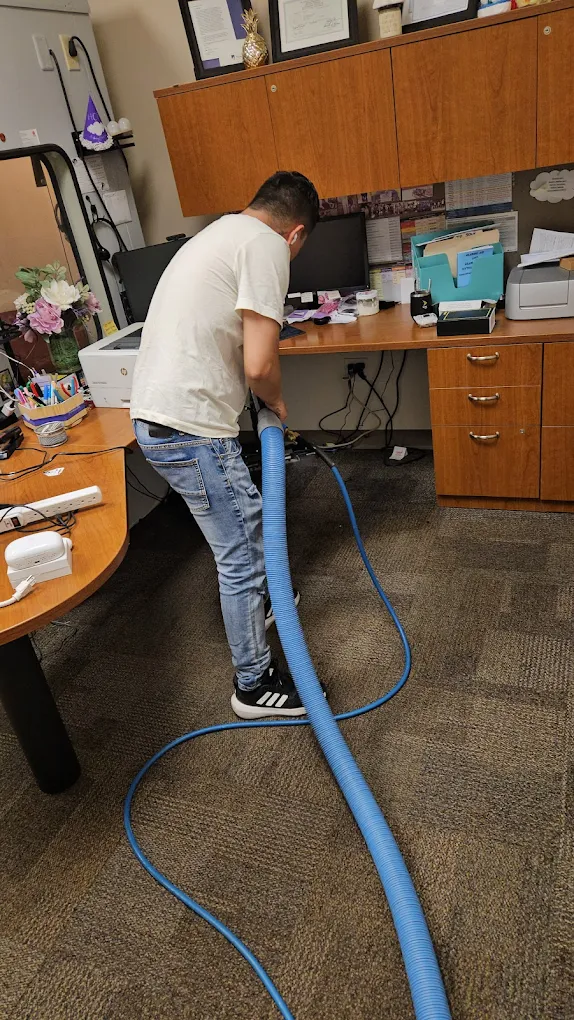
Offices, stores and medical offices
Offices. The main problems are traffic lanes in hallways, dull spots under desk chairs and coffee drips near the break room. Conference rooms often get forgotten until a client meeting is coming up. A yearly deep clean plus regular care of the walkways keeps most offices looking sharp.
Stores and showrooms. Customers judge a shop the moment they walk in. The entrance and the main aisle carry almost all the traffic, so those are the zones to keep on a tight schedule. Cleaning after closing means no wet floors during open hours.
Medical and dental offices. Waiting rooms see a steady flow of people in every kind of weather. Many owners also care about the products used. If you want gentler products in a space with patients, children or staff with allergies, ask about our organic carpet cleaning.
Many businesses also have fabric chairs in the waiting room, lobby sofas or upholstered conference chairs. These can be done on the same visit with upholstery cleaning, and if your restrooms or kitchen have tile floors, our tile and grout cleaning can be added too.
Common office stains and what to do about them
Most office stains fall into a few groups. Knowing which one you have helps you avoid making it worse while you wait for a professional.
- Coffee and tea. Blot right away with a dry white towel. Add a little cool water and blot again. Do not use hot water on fresh coffee with milk.
- Ink and toner. Do not rub. Toner powder should be vacuumed first, without any water, or it turns into a smear.
- Food and grease near desks. Scrape up what you can, blot, and leave the rest for a professional. Greasy spots attract dirt fast.
- Gum. Do not pull it while it is soft. A professional can remove it without tearing the fibers.
- Salt and slush. Let it dry, vacuum the crust, then have it rinsed out. Spraying more cleaner on salt usually makes the white line bigger.
For tough or old marks that will not lift, our stain removal service uses treatments matched to each kind of spot.
Office manager tip: keep a small spill kit by the break room: white towels, a spray bottle of plain water and a note with our number. A spill handled in the first few minutes is much easier to remove later.
How our crews clean a commercial space
Every job starts with a walk-through, so the price and the plan are clear before any work begins. Then the cleaning follows the same steps each time.
Walk-through and plan
We look at the zones, the carpet type and the stains, and agree on the hours and the method.
Dry soil removal
A thorough vacuum pulls out loose grit before any liquid touches the carpet.
Pre-treat and clean
Traffic lanes and spots get pre-treated, then the floor is cleaned with the method that fits.
Spots, check and dry
We go back over stubborn spots, walk the floor with you and leave it set up to dry.
Desks and chairs that can be moved safely are lifted or shifted and put back. Heavy furniture, server racks and file cabinets are cleaned around. Tell us in advance about anything that should not be moved.

Getting the space ready for cleaning day
A little preparation makes the visit faster and keeps the cost down. Share this list with your staff the day before.
- Clear the floor under desks: bags, boxes, power strips and loose cables.
- Pick up small items from the carpet in conference rooms and the waiting area.
- Tell us about alarm codes, building access and where the crew can park the van.
- Point out the worst spots and any area that must be open first in the morning.
- Let us know about anything fragile or anything that must not be moved.
- Ask staff to wait until the carpet is dry before rolling chairs back over it.
- Leave the heat or air conditioning on, which helps the carpet dry faster.
Between visits, a few simple habits keep the carpet looking good longer. Our guide on how to care for your carpets between professional cleanings is written for homes, but most of the tips work just as well in an office.
How commercial carpet cleaning is priced
Commercial carpet cleaning is priced by square footage, by the condition of the carpet and by the method. That is why we quote after a walk-through instead of over the phone with a guess. The price is confirmed before we start, so there are no surprises on the invoice. Booking online takes $20 off any service.
A regular maintenance plan often costs less over a year than waiting until the carpet is very dirty and then paying for a heavy restorative cleaning. It also helps the carpet last longer, which matters when replacing it means closing the office. For a general look at how cleaning prices work, read how much carpet cleaning costs on Long Island.
If you run a business from home, or you want your own house done too, our regular carpet cleaning starts at $119 for one room of any size.
Around Long Island
We clean business carpet across Nassau and Suffolk from our shop in Deer Park. Our crews work in office parks, main streets and shopping centers in towns like Hauppauge, Mineola, Farmingdale, Bay Shore, Freeport, Huntington and Ronkonkoma. See every town on our service areas page, or learn more about Long Island carpet cleaning.
Need the office carpet done without closing? We clean before you open, after you close or on weekends. The price is confirmed before we start, and booking online takes $20 off.
Call (516) 708-0278 Book online, save $20