
Short answer: "steam" carpet cleaning is hot water extraction. Hot water and cleaning solution go deep into the pile and are pulled right back out with strong suction, so the dirt leaves the house. "Dry" carpet cleaning uses very little water and mostly cleans the top of the fibers. Dry methods are faster to dry, but they leave more soil and residue behind. For most Long Island homes, especially with kids, pets, allergies or a carpet that has not been cleaned in a long time, steam cleaning is the better choice. Dry cleaning fits light, in-between touch-ups.
Call three companies and you may hear three different stories. One says steam is the only real clean. Another says dry is the only safe choice. A third says you can walk on the carpet in an hour. So which one is right? Here is the honest answer from the crews who do carpet steam cleaning on Long Island every day, in plain words and with no sales talk.
This guide explains what each method really does, where the dirt goes, how long each one takes to dry, what makes a steam clean go wrong, and how to choose for your own home. It also covers wool, basements, pets and the other special cases we see in Nassau and Suffolk homes.
What steam carpet cleaning really is
The name is a little misleading. A steam clean does not blow live steam into your carpet. The real name is hot water extraction. "Steam" stuck because the water is hot, and on a cold day you can see a little vapor at the wand.
Here is what happens in a real steam clean:
- Pre-spray. A cleaning solution goes on first. It loosens oily soil, body oils and the sticky film that holds dirt in the fibers.
- Agitation. In heavy areas the solution is worked into the pile so it reaches the base of the fibers, not only the tips.
- Hot water rinse. Heated water is sprayed into the pile under pressure. It flushes the loosened soil off the fibers.
- Extraction. In the same pass, strong suction pulls the water back out, and the dirt goes with it, through the hose and out to the machine.
That last step is the whole point. The dirt does not get pushed around. It leaves your house in the dirty water tank. This is the method most carpet makers recommend, and it is the main method behind our carpet cleaning service.
What "dry" carpet cleaning really is
"Dry" carpet cleaning is not one method. It is a name for several low-moisture methods. None of them is fully dry. They just use much less water than a steam clean. The common ones are:
- Dry compound (powder). A damp, absorbent powder is brushed into the carpet. It grabs soil, and then it is vacuumed up.
- Encapsulation. A cleaning solution is sprayed on and brushed in with a machine. As it dries, it wraps around soil so it can be vacuumed later.
- Bonnet cleaning. A spinning pad wet with solution buffs the top of the carpet. The pad picks up dirt from the surface.
- Dry foam or shampoo. A foam is worked in with brushes and then vacuumed or lightly extracted.
What these have in common: there is no full rinse. The cleaning happens mostly on the upper part of the fibers. What the vacuum or the pad does not pick up stays in the carpet. That can be fine for a light, quick refresh. It is a real problem when the carpet is full of deep soil, sand, pet accidents or old cleaning residue.
Tip from our crews: ask any company one simple question: "Where does the dirt go?" With a steam clean, the answer is "into our tank, and out of your home". With a dry method, the answer is usually "into the pad or the powder, and then into the vacuum", and some of it stays behind.
Where the dirt hides, and what each method reaches
Carpet is deeper than it looks. Most of the soil in a home carpet is not on top. It falls down the fibers and settles near the base, close to the backing. That is why a carpet can look fine from standing height and still feel gritty, smell stale, or turn gray again a week after a quick clean.
On Long Island, that bottom layer collects a lot. Beach sand comes home on feet and towels all summer. Road salt and slush come in all winter, and our guide to road salt stains on carpet shows how salt hides at the base of the pile and comes back as white lines. Sand and salt both act like sandpaper on the fibers every time you walk on them. A surface clean leaves them right where they are.
Steam vs dry: side by side
Here is how the two compare on the things most homeowners care about.
| Dry (low-moisture) cleaning | Steam (hot water extraction) | |
|---|---|---|
| How deep it cleans | Mostly the top of the fibers | Down to the base of the fibers |
| Rinse | No full rinse | Full hot water rinse |
| Where the dirt goes | Into a pad, powder or later vacuuming | Out of the house in the dirty water tank |
| Residue left behind | More likely, and residue attracts new dirt | Little to none when rinsed right |
| Sand, grit and salt | Mostly stays in the pile | Flushed and pulled out |
| Pet accidents | Not enough on its own | Works with enzyme treatment |
| Drying time | Faster | About 4 to 8 hours with good airflow |
| Best for | Light touch-ups between deep cleans | A real, deep clean of a home carpet |
Neither method is "bad". They are tools for different jobs. The trouble starts when a quick surface method is sold as a deep clean. If a carpet has not been cleaned in a year or more, a dry method alone will not get it back to clean.
5 myths about steam cleaning
Most of the worry about steam cleaning comes from bad experiences with weak machines, not from the method itself. These are the myths we hear most often on Long Island.
The one thing that is true: a poor steam clean can over-wet a carpet. That is why the equipment and the person holding the wand matter so much. More on that below.
Drying time: the real difference
Speed is the main reason people ask about dry cleaning. And it is true: low-moisture methods dry faster because less water goes in. But a well-done steam clean does not leave your carpet wet for days either. With strong extraction, carpet should be damp, not wet, and dry in about 4 to 8 hours. Running the AC or a fan helps.
What changes drying time in a Long Island home:
- Humidity. A muggy August day slows drying. Air conditioning pulls moisture out of the air and speeds it up a lot.
- Basements. Carpet over a concrete slab dries slower. A dehumidifier and a fan make a big difference.
- Airflow. Open doors between rooms, ceiling fans on, and a box fan pointed across the floor.
- Heavy spots. Areas that got extra treatment for stains or pets can take a little longer than the rest of the room.
- Thick plush carpet. Dense, deep pile holds more moisture than a low, tight loop pile.
Tip from our crews: plan your clean for a morning, set the thermostat or AC so the air keeps moving, and keep pets off the carpet until it feels dry to your bare hand. Walk on it in clean socks, not shoes, until it is fully dry.
If you need the room back today, for guests or a showing, ask about same-day carpet cleaning. We are open 24 hours, 7 days a week.
How to choose for your home: 6 simple questions
Not sure which one your carpet needs? Go through these questions in order. Most homes get a clear answer by question three.
- When was it last deep cleaned? If it has been a year or more, or you don't remember, it needs a steam clean. Our guide on how often to clean carpet on Long Island explains the usual 12 to 18 month rule.
- Do you have pets? Accidents, oils and dander sit deep in the pile and pad. Steam cleaning with enzyme treatment is the right tool. See why pet urine smell comes back in carpet.
- Does anyone have allergies? Dust, dander and pollen settle at the base of the fibers. A full rinse and extraction removes far more of it than a surface method.
- Is there sand, salt or gritty soil? Beach houses, homes near the water and front rooms in winter collect grit. That needs to be flushed out, not buffed.
- Is it wool or a delicate fiber? Wool can be steam cleaned, but at a lower temperature with a wool-safe rinse. Tell us the fiber when you book.
- Is it a light refresh in a low-traffic room? A guest room that is only used a few times a year may only need a light clean. We will tell you honestly if a full clean is more than the room needs.
Still not sure? Our article on what is included with professional carpet cleaning lists what a proper visit should cover, so you can compare any quote you get.
How our crews steam clean a carpet
A good steam clean is a process, not just a wand going back and forth. This is how our crews do it in homes across Nassau and Suffolk.
Walk-through first
We look at the fiber, the traffic lanes, the stains and the pet spots, and confirm the price before we start.
Pre-spray and spot work
Traffic lanes and spots get treated first, so the oily soil lets go of the fibers.
Hot water extraction
Hot rinse and strong suction, with slow, overlapping passes and extra dry passes at the end.
Groom and set up airflow
We groom the pile so it dries evenly and help set up fans or AC for fast drying.

A clean, full rinse also matters in homes with small kids. Less leftover soap means less residue on little hands and knees. If you want the gentlest products, ask about organic carpet cleaning. And if you worry about your dog or cat, read can carpet cleaning be harmful to my dog.
Truck-mounted vs portable steam cleaning
Not all steam cleans are equal. The machine makes a big difference in how much soil comes out and how much water stays behind.
Truck-mounted units run from the van outside. They make much hotter water and much stronger suction than any machine you can carry. More dirt comes out, and less water stays in the carpet, so it dries faster. That is our first choice for most houses.
Portable units are carried into the home. We use them where the hoses from the van can't reach, like apartments, upper floors in tall buildings, and some tight spaces. A good portable unit still does a real hot water extraction. It just works a little slower.
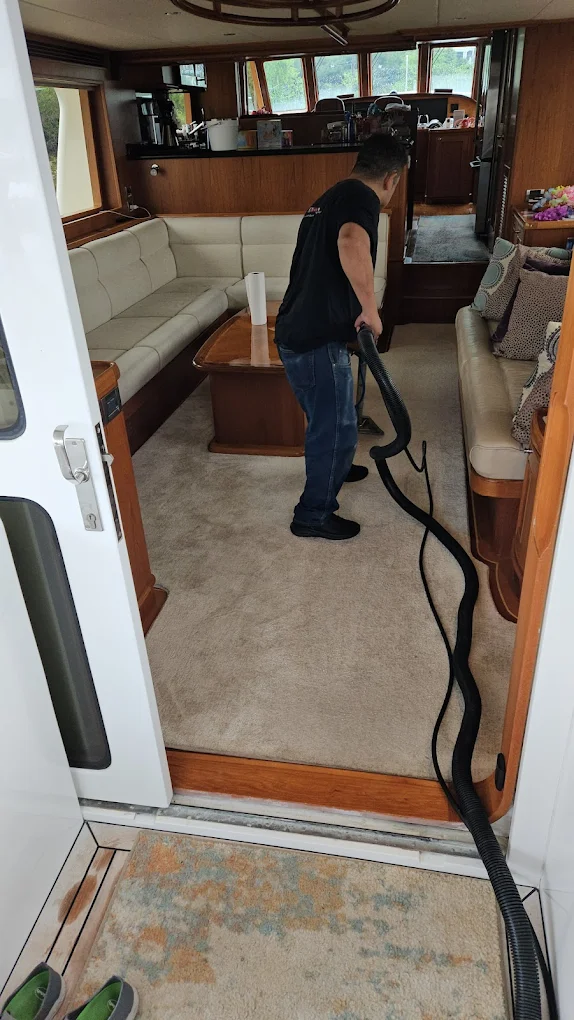
A rental machine from the store is a different thing. It has a fraction of the heat and suction. People often put down too much soap and can't pull enough water back up. The result is a carpet that stays wet for a long time, gets sticky, and gets dirty again fast. If you have tried one and were not happy, that is not a problem with steam cleaning. It is a problem with the machine.
Special cases: wool, basements, pets and offices
Wool carpet. Wool is a strong, beautiful fiber, but it does not like high heat or harsh chemicals. We clean wool at a lower temperature with a wool-safe rinse, and we take extra care with extraction so it dries evenly.
Basement carpet. Basements are the place where low-moisture work and very strong extraction both matter. Carpet over concrete dries slower, so we make extra dry passes and help set up a dehumidifier or fan. If the basement carpet got wet from a leak or flood, that is a different job. Read whether carpet must be replaced after water damage first.
Pet homes. A dry method can make a pet spot look better for a while, but it does not reach the urine salts in the backing and pad. Pet areas need enzyme treatment and extraction, which is what our pet stain and odor cleaning adds to a steam clean.
Tough stains. Coffee, wine, rust, ink and old mystery spots each need their own treatment before the rinse. Our stain removal service handles those, and we tell you first if a spot may not fully come out.
Offices and stores. Businesses often need the floor back fast and the work done after hours. We plan around your schedule. See commercial carpet cleaning for how we work in offices and shops.
Why it matters more on Long Island
Long Island homes are hard on carpet in a few special ways. Summers are humid. Many homes are close to the water, and sand comes in with every trip to the beach. Fall brings weeks of rain and wet leaves on shoes. Winter brings road salt, slush and closed windows for months. And many houses have finished basements, where carpet sits over cool concrete.
All of this adds up to more fine grit and more moisture-loving soil deep in the pile. That is exactly the kind of soil a surface method leaves behind. It is also why a carpet that only gets quick dry cleanings can look tired and gray even when it was "cleaned" not long ago.
If you own your home and plan to keep the carpet for years, a real deep clean at the right times is the cheapest way to make it last. Our residential carpet cleaning page explains what a home visit includes.
What steam carpet cleaning costs
Our steam carpet cleaning starts at $119 for one room of any size. The price is confirmed before we start, so there are no surprises at the end. Booking online takes $20 off any service. For the full picture, including what can add to a price and how to spot a bait-and-switch quote, read how much carpet cleaning costs on Long Island.
Be careful with very low "whole house" prices for a dry or steam clean. Often the low price covers only a fast surface pass, and the real work shows up as add-ons once the crew is in your home. Always ask what the price includes before anyone starts.
Around Long Island
Our crews steam clean carpets all over Nassau and Suffolk from our shop in Deer Park. That includes towns like Westbury, Plainview, New Hyde Park, Kings Park, Bellport and Riverhead. See every town on our service areas page, or learn more about Long Island carpet cleaning.
Ready for a real deep clean? Hot water extraction, a full rinse and strong suction, with the price confirmed before we start. Booking online takes $20 off.
Call (516) 708-0278 Book online, save $20